Europe on Fire: Violent protests rock France, Belgium, Italy and Portugal; 1,200 arrested in France
Babushahi Bureau
Brussels (Belgium), October 18, 2026: Hundreds of thousands of people took to the streets across France, Belgium, Italy and Portugal on Saturday to protest rising living costs, low wages, expensive housing and deteriorating public services, putting governments under pressure amid growing public discontent.
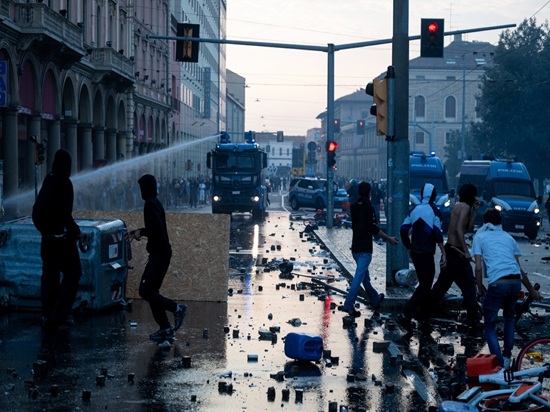
The demonstrations, held separately and without a central coordinating organisation, turned violent in several cities, with clashes between protesters and police, looting, arson and damage to public property reported in parts of France and Italy. Security forces also used tear gas and water cannon to disperse crowds in Belgium.
France witnessed the largest mobilisation, with more than 5.5 lakh people participating in demonstrations nationwide, according to the French Interior Ministry. Prime Minister Sébastien Lecornu said 1,200 people had been arrested and 150 police personnel injured during the unrest.
The protests, which initially gained momentum through student-led demonstrations against education budget cuts and poor school conditions, have broadened to encompass wider concerns over purchasing power, economic inequality, housing affordability and employment prospects.
France sees widespread unrest
France experienced one of its most turbulent days of demonstrations in decades, with protests spreading across Paris and several other major cities, including Marseille, Nice, Nantes, Bordeaux, Lille, Toulouse and Strasbourg.
According to figures cited by French authorities, approximately 5.5 lakh people participated in the nationwide demonstrations, including around 1.1 lakh in Paris.
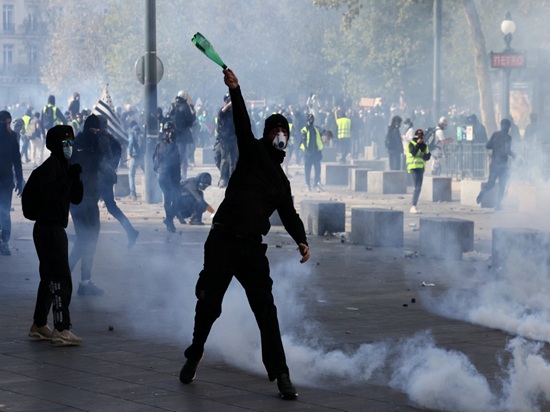
While many demonstrators marched peacefully, groups of masked protesters clashed with police, targeted businesses and public buildings, and set fires. Shops and supermarkets were looted in several cities, while police vehicles and officers were also attacked.
Lecornu said 150 police personnel had been injured. The authorities reported 1,200 arrests, with Paris alone accounting for 855 detentions, according to reports by French media.
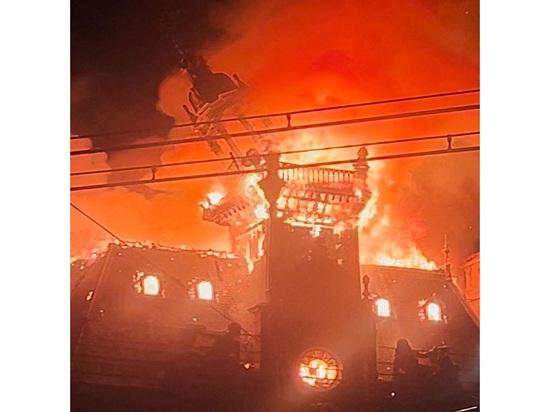
In Limoges, a fire started by masked protesters severely damaged the city’s historic town hall, a building more than 140 years old. Authorities later said the blaze had been contained. Public buildings in Marseille and Lille were also reportedly broken into and vandalised, while protesters set fire to Lyon’s tourist office.
Paris Mayor Emmanuel Grégoire said entire streets in the capital had been devastated. Deputy Mayor Lamia El Aaraje described the level of violence in Paris as unprecedented in her experience.
President Emmanuel Macron condemned the destruction and said those responsible for attacking public institutions and looting businesses would face prosecution.
The demonstrations began with student concerns over budget cuts and poor conditions in schools but have increasingly drawn support from people dissatisfied with the cost of living and the government’s economic policies. Former figures associated with France’s Yellow Vest movement, which emerged in 2018 over fuel prices and economic inequality, were also expected to join the mobilisation.
Italy: Clashes in Milan, Bologna
In Italy, demonstrations against rising living costs, inflation, low wages and strained public services were accompanied by violent confrontations in Milan and Bologna.
In Milan, protesters clashed with riot police in the city centre, including around Piazza del Duomo. Masked individuals reportedly threw stones, paving blocks and other objects at officers, set barricades on fire and damaged shops and other property.
Police responded with tear gas and water cannon to disperse the crowds. The violence disrupted the march and forced authorities to clear parts of the city centre.
Italian media reports said around 50 demonstrators were detained in Milan, while approximately 12 people were hospitalised following the clashes. At least two police officers were reported injured.
The mobilisation in Milan attracted more than 5,000 participants, according to reports, as students and other demonstrators raised concerns about inflation, inadequate funding for public healthcare, deteriorating school conditions and government policies.
In Bologna, protesters also clashed with police near the central railway station. Authorities deployed riot police, water cannon and tear gas after demonstrators allegedly threw stones, bottles and other objects at security personnel. The disturbances prompted precautionary measures, including the temporary closure of the railway station.
Italian Prime Minister Giorgia Meloni condemned the violence while defending the right to peaceful protest.
“Demonstrating is a right. Setting our cities ablaze is not,” Meloni said in a statement posted on X.
She said she respected the thousands of people who had participated peacefully in the demonstrations but criticised those who attacked police officers and damaged public property.
Meloni also urged opposition parties to condemn the violence unequivocally, arguing that political differences should not justify attacks on law enforcement personnel or the destruction of cities.
Milan Mayor Giuseppe Sala said the protesters’ grievances were understandable but maintained that violence against police and damage to the city could not be justified.
Belgium: Police use tear gas, water cannon
Belgium also witnessed confrontations between demonstrators and police, particularly in Brussels, where student protests over university registration fees had already continued for weeks.
Police fired tear gas and used water cannon to disperse crowds after accusing some protesters of throwing objects at officers and starting fires.
Similar measures were reported in Liège, east of Brussels, as authorities attempted to break up demonstrations. Officials did not immediately provide an estimate of the number of participants.
The protests reflect mounting concerns among sections of the population over the cost of living and access to education, adding to the pressure on authorities already dealing with student-led mobilisation.
Portugal: Housing, rents and low wages fuel anger
In Portugal, tens of thousands of people marched through Lisbon to demand higher wages and pensions and action on the growing cost of housing and rising living expenses.
The demonstrations were called by the country’s CGTP trade union confederation, with protesters highlighting the widening gap between household incomes and the cost of basic necessities.
Housing affordability was a central concern. House prices in Portugal have more than doubled since 2017, while rents for new leases have risen sharply over the same period, making it increasingly difficult for many people to find affordable accommodation in major cities.
Demonstrators also protested against low wages and rising fuel costs. Some set up tents in central Lisbon to draw attention to the housing shortage and soaring rents.
Portuguese Parliamentary Affairs Minister Carlos Abreu Amorim said on Friday that the government would not give in to pressure from street demonstrations.
Protesters, however, accused political leaders of being disconnected from the difficulties faced by ordinary households.
Unlike the violent confrontations reported in parts of France and Italy, the principal focus of the Lisbon mobilisation was the demand for better living conditions, affordable housing and improved incomes.
No single movement, but common grievances
Despite taking place in different countries and without a unified organising structure, the demonstrations have brought similar economic and social concerns into focus.
Alberto Alemanno, a professor of European Union law and policy at HEC Paris Business School, told Al Jazeera that France appeared to be at the centre of the growing wave of unrest, with signs that public discontent was spreading beyond its borders.
He cautioned against treating the protests as a single, coordinated movement, noting that they reflected different national circumstances but shared grievances.
Underfunded education, rising living expenses and uncertainty over employment prospects, particularly among young people, were among the common concerns driving the demonstrations.
Alemanno also pointed to the possibility of further mobilisation in other European countries, including Greece, Germany and Austria, where he said early signs of protest activity were emerging.
Governments face mounting political pressure
The demonstrations come at a politically sensitive time for Europe, with national elections scheduled in several countries over the coming 12 months, including Spain, France, Italy and Poland.
The scale of the protests could push the cost of living, public spending, housing affordability and the condition of public services higher on the political agenda.
For governments, the immediate challenge is to respond to citizens’ economic concerns while preventing violent incidents from escalating. The events in France and Italy have also renewed debate over how authorities should manage large demonstrations without undermining the right to peaceful assembly.
Although the protests differ in their immediate triggers and intensity, the message from the streets is similar: many people are struggling to reconcile their incomes with the rising cost of everyday life.
Whether the demonstrations lead to policy changes or trigger further unrest remains uncertain, but the scale of Saturday’s mobilisation has made economic hardship a pressing issue for governments across the European Union.