Chandigarh University hosts 4th International Summer School 2026
International Faculty, Students Converge for Academic Exchange on Future of Architecture and Urban Planning
Babushahi Bureau
Mohali (Punjab), September 9, 2026: The 4th International Summer School 2026, themed ‘Reimagining Chandigarh’s Neighbourhood’, commenced at Chandigarh University on Monday, bringing together 50 students and faculty members from Slovakia, the Philippines, Nepal, Bangladesh and South Africa for a 10-day international academic exchange.
Organised by the University Institute of Architecture, Chandigarh University, in collaboration with the Office of International Affairs and the International Council on Monuments and Sites (ICOMOS) India, the programme will provide participants with an immersive, field-based learning experience focused on urban planning, architecture, heritage and community needs.
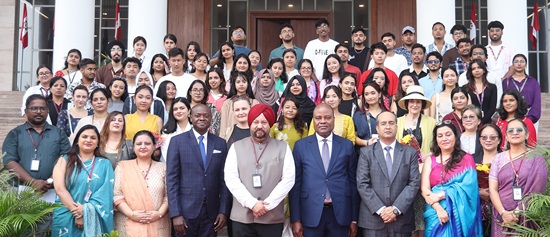
The programme seeks to explore how neighbourhoods can be made more inclusive, resilient, sustainable and responsive to communities by drawing lessons from Chandigarh’s distinctive urban form, heritage and public spaces.
The inaugural session was attended by Erick Jean Marie Zinsou, Ambassador of the Republic of Benin to India, as the Chief Guest. The Guests of Honour included Prof. (Dr.) June Jordaan, Cape Peninsula University of Technology, South Africa; Prof. Ma Regina P. Falconite, Iloilo Science and Technology University, Philippines; Priyanka Sagar, GIS Specialist and Founder of Arcotec Design Studio; Senthilkumar P, Architect and Urban Planner, Chandigarh University; Dr. Ashita Chadda, Executive Director, Liberal Arts & Humanities; and Dr. Rajan Sharma, Executive Director, Department of International Affairs, among other dignitaries.
Focus on Resilient and Sustainable Architecture
Speaking during the programme, Priyanka Sagar highlighted the importance of region-specific architectural planning in disaster-prone areas such as the Himalayas. She stressed that modern development should take natural terrain, drainage systems, rivers and mountains into account.
She also underlined the potential of Geographic Information Systems (GIS) in identifying vulnerable areas and said contemporary planning could benefit from combining modern technologies with traditional architectural knowledge. Traditional construction methods such as the Dhajji Dewari system in Kashmir, along with the use of local materials, she noted, offer important lessons in designing structures that can withstand natural hazards.
Senthilkumar P, Architect and Urban Planner at Chandigarh University, said studying Chandigarh’s sectors provides an opportunity to understand how the city’s original planning principles can be preserved while responding to increasing population and vehicular pressure.
He said the university’s ongoing study on decongesting Chandigarh’s sectors and roads, with Sector 22 as a case study, is examining ways to improve accessibility, walkability and public spaces without compromising the sustainability of Chandigarh’s sector-based planning model.
According to him, Chandigarh’s well-planned and relatively self-sufficient neighbourhoods remain one of the city’s major strengths, while emerging challenges need to be addressed without losing the principles that shaped its urban identity.
AI, Heritage and the Future of Cities
Prof. (Dr.) June Jordaan of Cape Peninsula University of Technology, South Africa, discussed the growing role of artificial intelligence and other emerging technologies in architecture.
She said AI should be viewed as a tool to support and enhance architectural work rather than replace human creativity, intuition and lived experience. According to her, architecture must continue to place human experience at the centre even as technological capabilities expand.
Jordaan also praised Delhi’s urban environment, particularly its green spaces, human-scale development and vibrant public life.
Ambassador Erick Jean Marie Zinsou urged students to make the most of the international academic platform and focus on developing skills that can contribute to the future of urban spaces.
He emphasised the growing demand for skilled professionals in an increasingly competitive global environment and encouraged students to use the opportunity to broaden their knowledge and perspectives.
Prof. Ma Regina P. Falconite, Guest of Honour from Iloilo Science and Technology University, Philippines, stressed that heritage conservation is closely linked to preserving cultural identity for future generations.
She said Punjab’s architectural and cultural heritage, including traditional settlements, forts, Sikh sacred sites and evolving urban spaces, offers valuable lessons in balancing modernisation with heritage conservation. She also highlighted the importance of international academic exchanges in developing solutions that can be adapted to different communities.
The Summer School goes beyond conventional classroom learning, with participants undertaking field mapping, walkability assessments, density and land-use studies, space syntax analysis, heritage and public-realm documentation, community interaction and studies related to thermal comfort in urban spaces.
Through these activities, participants will examine how neighbourhoods can be redesigned to become more inclusive, resilient, sustainable and responsive to community needs.
The programme will also allow international participants to study Chandigarh as a living laboratory of modern urban planning while bringing perspectives from different countries to the city's neighbourhood-level challenges.
As part of the programme's academic outcomes, participants will prepare final presentations and contribute to a collaborative research publication based on their field observations and interdisciplinary discussions.
The initiative is expected to strengthen academic cooperation, cross-cultural learning and research partnerships among participating institutions, faculty members and scholars.