Farmers delegation led by Bhupinder Singh Mann meets Shivraj Chauhan, presses for urgent Agricultural Policy reforms
Babushahi Network
New Delhi/Chandigarh, August 5, 2026:
A meeting of All India Kisan Coordination Committee headed by Bhupinder Singh Mann EX MP, Chairman All india Kisan Coordination Committee was held with Union Agriculture Minister Shivraj Singh Chauhan in which farmer delegation pressed for immediate agricultural police reforms.
Delegation submitted a memorandum to the Agriculture Minister.
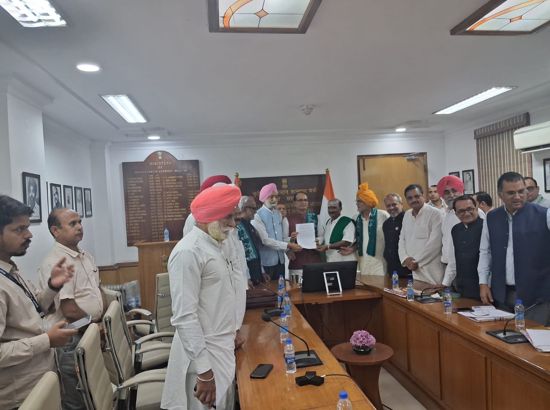
Read detailed memorandum below:
To
Hon’ble Shri Shivraj Singh Chouhan
Union Minister of Agriculture and Farmers’ Welfare
Government of India
Krishi Bhawan, New Delhi
Subject: Memorandum on urgent agricultural policy reforms
Respected Shri Chouhan Ji,
At our meeting with you on 4 August 2026, the All India Kisan Coordination Committee respectfully submits this memorandum for your urgent consideration.
Indian agriculture needs a policy framework centred on farmers’ incomes, competitive markets, modern technology and freedom of choice. Diversification cannot succeed unless alternative crops have assured markets and remunerative prices.
1. Ethanol must support farmers and diversification
India’s ethanol programme is a positive step towards energy security and additional demand for agricultural produce. However, its benefits must reach farmers.
The E20 debate should be addressed through independent scientific evidence.
In water-stressed regions, ethanol policy should promote maize, sugarcane, sorghum, crop residue and other low-water feedstocks instead of further incentivising paddy.
FCI supplied about 63.5 lakh tonnes of rice to ethanol plants between June 2025 and June 2026 at ₹2,250-2,320 per quintal, against its average acquisition cost of ₹3,719.72 per quintal in 2024-25 and ₹3,889.46 in 2025-26. The sale price is also below the maize MSP of ₹2,410 per quintal for 2026-27.
This pricing can divert demand away from maize and disadvantage other feedstocks. Maize and sugar cane growers should receive MSP-linked procurement or price support before large quantities of FCI rice are released to distilleries. FCI rice should not undercut alternative feedstocks, and a stable five-year feedstock and ethanol-pricing policy should be announced.
Ethenol policy should be such that it encourages crops that produce ethanol and effect diversification so that our dependence on import of fossil fuels is reduced.
Also a aggressive communication should be launched to counter the negative narrative being built around the ethanol blended fuels.
2. MSP and competitive markets must work together
MSP is an essential safety net, but government procurement cannot cover every crop and farmer. Farmers need MSP protection when markets collapse and the freedom to obtain higher prices when markets are favourable.
Farmers should have the choice of selling through mandis (APMC) or alternative markets. e-NAM must become a genuine national market with common quality standards, reliable assaying, interstate logistics, dispute resolution and unified trader licensing.
Farmers should also have regulated access to futures and options through exchanges such as NCDEX. The blanket suspension of futures trading in major agricultural commodities should be independently reviewed. Properly regulated, delivery-based futures markets can provide price discovery and protection against market risk.
This is also be helpful for super fine rice like basmati like globally is must for agrarian economy.
3. Farmers must receive the seeds of today
The Green Revolution succeeded because farmers received the best seeds and technology then available. Today’s farmers must similarly have access to biotechnology-enabled, climate-resilient and high-yielding seeds.
Approvals should follow a scientific, transparent and time-bound process. Once safety is established, farmers should be free to choose. India cannot expect its farmers to compete against imports produced using biotechnology while denying the same technology to domestic growers.
The proposed Seeds Bill, 2025, must protect farmers’ rights to save, sow, re-sow, exchange and share farm-saved seed, while holding commercial suppliers accountable for spurious seeds, false claims and poor germination.
Misinformation about the Bill should be countered through credible scientists, agricultural universities and farmer representatives. Genuine concerns should be answered clause by clause. Agricultural universities also need greater research funding, linked to improved varieties, seed multiplication, farmer adoption and effective extension work.
4. Punjab and Haryana need an agricultural transition package
The farmers of Punjab and Haryana ensured India’s food security by investing heavily in machinery, irrigation and inputs for the national wheat and rice pool. Much of their debt was accumulated while fulfilling this national responsibility.
The same system locked these states into the wheat-paddy cycle, resulting in groundwater depletion, soil deterioration and rising debt. This distress cannot be treated solely as a failure of individual farmers or state governments.
Punjab and Haryana require a Centre-State transition package covering:
- Restructuring of verified distressed institutional farm loans and appropriate interest relief.
- MSP-linked support and assured marketing for maize, pulses and oilseeds.
- Income protection for farmers shifting away from paddy.
- Processing, storage, crop insurance and infrastructure for alternative crops.
- Greater fiscal support for horticulture, livestock, agroforestry, drip and micro-irrigation.
- Central assistance for restoring canals, distributaries and field channels.
This would not be charity. It would recognise their contribution to national food security and the ecological cost borne by their farmers.
5. A National Agricultural Policy with clear responsibilities
Agricultural governance is fragmented and overlapping. Agriculture and agricultural markets fall primarily under the State List. Trade and distribution of foodstuffs come under the Concurrent List, while interstate trade, futures, imports, exports and major procurement decisions are controlled or influenced by the Union Government.
A state may promote a crop, but its import-export policy is determined by the Centre. States regulate markets, while a central regulator controls futures. FCI releases and stock limits can again alter prices. When policy fails, responsibility becomes unclear.
A comprehensive National Agricultural Policy should be prepared in consultation with states and genuine farmers’ organisations. The Seventh Schedule and laws governing agricultural production, marketing and trade should be reviewed to remove overlaps without weakening the federal structure.
The Essential Commodities Act, 1955, also requires reform. Stock limits and movement restrictions should be imposed only during clearly defined shortages, on published criteria and for a limited duration. Sudden restrictions discourage investment and depress farm prices.
Farmers also need stable import-export policies. Export bans, duties or duty-free imports announced after sowing destroy the price signals on which farmers have acted. Except during genuine emergencies, major trade-policy changes should be announced before sowing. Ministry of Commerce should put import and export restrictions in consultations with Ministry of Agriculture.
Consumers need to be protected, but farmers should not bear the burden of controlling food inflation. Poor consumers may be supported through the Public Distribution System, targeted assistance and a price-stabilisation fund, not by suppressing farm prices.
We request the Government to constitute a National Agricultural Policy Commission with a six-month mandate. It should include the concerned Union Ministries, states, genuine farmers’ organisations, ICAR, agricultural universities, economists and market experts. It should prepare a draft after extensive consultation and submit a time-bound implementation roadmap.
India’s farmers need fair prices, modern technology, competitive markets and freedom from sudden policy reversals, emphasis on agro processing including ethanol and bio waste management for CBG. We request your personal intervention in initiating these reforms.
With regards,
Yours sincerely,
Bhupinder Singh Mann
Those present
1. Bhupinder Singh Mann Ex MP
2. Gurpartap Singh Mann
3. Gunvant Patil, General Secretary AIKCC
4. Guni Prakash President BKU Mann (Haryana
5. Manikandam President Vasagal Sangam Tamil Nadu
6. Balraj Singh Randhawa General Secretary BKU Mann
7. Binod Anand Vice presiednt AIKCC
8. Balpreet Singh General Secretatry
9. Shivraj Singh
10. Subhakar Rao President Kisan Organisation Telengana
11. Balwant Singh Nadiali President BKU Mann (Mohali)
12. Manphool Singh
13. Lalit Bahale (President Shetkari Sngathana, Maharashtra)
14. Dinesh Sharma General Secretaty Shetkar Sangathna
15. Ajay Anmol President BKU Mann (Uttar Pradaseh)
16. Kisan Subrat Mani Tripathi Nationa General Secretary BKU Mann