Three-day International Moot Court Competition on AI & IPR concludes at Chandigarh University Ghrauan Campus
AI Can Assist in Making Humans Faster and Efficient but It Should Never Be Allowed to Replace Human Intelligence, says Justice Alok Jain, judge, Punjab and Haryana High Court at Chandigarh University
Christ University wins ‘Juris Nexus 2026’, India’s biggest International Moot Court Competition on AI & IPR at Chandigarh University
Babushahi Bureau
Mohali (Punjab), September 26, 2026: A team from Christ University won the three-day ‘Juris Nexus 2026’, India’s biggest International Moot Court Competition on Artificial Intelligence (AI) and Intellectual Property Rights (IPR), hosted by Chandigarh University from 24 September to 26 September with participation of 112 teams from 20 States and six countries.
The dignitaries who graced the valedictory session of the ‘Juris Nexus 2026’ was graced the dignitaries including the chief guest Justice Alok Jain, judge, Punjab and Haryana High Court, Advocate Pawan Kumar Mutneja Advocate General Haryana, Dr Balram K Gupta, Senior Advocate, Supreme Court and former Director, National Judicial Academy and Director (Academics) Chandigarh Judicial Academy, , Prof (Dr) SS Sehgal, Vice-Chancellor, Chandigarh University and Dr Nitin Malik, Registrar, Gujrat National Law University.
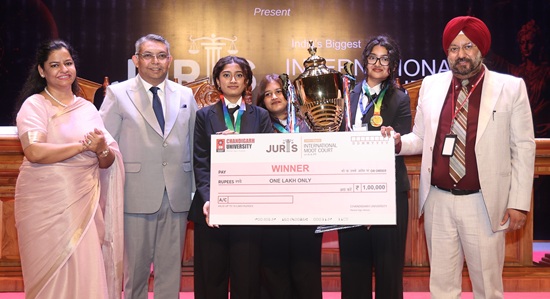
The Christ University’s team, comprising of Aditi Shashikumar, Vaishnavi Alva and Sharadhi S Rao, secured first position to win Rs 1 lakh prize of ‘Juris Nexus 2026’. The Regional Centre of Panjab University, Ludhiana, team, comprising of Gunitinder Kaur, Harveen Kaur and Neha, emerged as the runners-up team to win a prize of Rs 50 thousand. While Bharati Vidyapeeth University’s Law Students won Best Researcher Award, Maharashtra National Law University Pune students won Best Mooter Award and Saveetha School of Law won Best Memorial award.
In his keynote address on the occasion, the chief guest Justice Alok Jain, judge, Punjab and Haryana High Court said, “Technology is changing the legal profession and law students must learn to use every tool available. Let AI assist your mind, make you faster and more efficient but never let it replace your mind. The real learning lies in developing a mind that knows what to ask, why to ask it and what significance the answer would have. Information is not knowledge. AI may tell you what the law is, but understanding why that law exists how it has evolved and how it applies to human situations is something you have to develop yourself. With digitalisation, the nature of crime has also changed, with cybercrimes and technology-driven offences creating new legal challenges. At the same time keep the student in yourself alive.”
“Law teaches you many things, but some lessons cannot be taught by textbooks or classrooms. They come through practice, experience and sometimes mistakes. As entering the profession, the lawyers should remember that your responsibility is not merely to win a case, it is to assist the court in arriving at the correct decision. Ethics means knowing what we ought to do when we have an option of doing otherwise. If a judgment goes against your case or has been overruled, it is your duty to bring it to the knowledge of the court and then explain why it may not apply to your facts. You may lose that case, but you will earn the trust of the court. Reputation is built through hundreds of small things we do every day. People rarely come to a lawyer in happy times, so compassion, kindness and the ability to listen are essential,”.
Earlier in his welcome address, Prof (Dr) SS Sehgal, Vice-Chancellor, Chandigarh University said, “AI is transforming industries, economies, and societies across the world and has specially accelerated the pace of innovation across the world which is evident from the fact that the number of AI-related patents filed worldwide went up to over 3.40 lakh by 2025 and US has registered 33% increase in AI patents since 2018. But as AI has simultaneously raised complex questions concerning ownership, innovation, accountability, creativity, and the future of intellectual property law, over 1,000 AI-related lawsuits were filed globally between 2020 and 2025. So as an International Moot Court Competition, Juris Nexus 2026, reflected the real-world disputes arising at the intersection of technology and law,” he added.
In his address, Advocate Pawan Kumar Mutneja Advocate General Haryana, said, “Every challenge we face in life—especially the complex and difficult ones—offers us an opportunity to learn and grow. The more complex the problem, the more one learns about the subject matter. Students should always uphold the values instilled in them by their parents, teachers, friends, and education. Understand the problem, make decisions based on your values, and move forward. A decision may face challenges, but if it is made based on the right values and to the best of one’s ability, it will provide strength and self-confidence in life,”.
Dr Nitin Malik, Registrar, Gujrat National Law University said, “Students today have better facilities compared to the past. Technology and AI have provided students with enhanced learning opportunities, however, there is no substitute for knowledge and experience in the field of law. The legal profession inspires one to learn something new, unlearn old concepts, and relearn continuously. Students should leverage technological advancements while maintaining a commitment to continuous learning, as the journey to becoming a successful legal professional is one of constant learning,".
The final round of the Moot Court Competition was adjudicated by a seven-member panel of distinguished legal dignitaries including Adv Davinder Pal Singh, Additional Solicitor General of India, Supreme Court, Adv Vivek Narayan Sharma, Advocate-on-Record (AOR), Supreme Court of India, Dr Rashmi Nagpal Principal, Army Institute of Law Mohali, Dr Raghavender GR, Senior Consultant (IPR), DPIIT, Union Ministry of Commerce & Industry, Adv Chanchal Singla, Additional Advocate General, Punjab & Haryana High Court, Senior Adv Rohit Sud, President, Punjab and Haryana High Court Bar Association and Adv Suvir Sidhu Member, Bar Council of India.
The moot problem of ‘Juris Nexus 2026’ revolved around a fictional international dispute over the use of copyrighted works in generative AI. In the final of the Moot Court competition, the Christ University team as respondent for Republic of Aryavarta, NeuroGen Global Inc & CreativeEdge International Ltd) against the appellant (Global Creators Alliance & Federation of Novaris, argued that copyright laws are non-applicable to AI generated content as AI uses copyright works as data only and patterns are used by AI to reproduce which is not restricted by any explicit law. The winner team argued that the nature of AI works is different from copyrighted works and the alleged losses to copyright holders in the case are unfounded and AI is creating a new market which doesn’t infringe on the rights of the original art works or supersede such works. The Christ University team also argued that International Court of Digital Innovation and Intellectual Property (ICDIIP) has no jurisdiction in case as the case can only disposed by Dispute Settlement Board of World Trade Organization (WTO) which is the competent authority to decide such cases between the two countries.
With a prize pool of over Rs 1.8 lakh, Juris Nexus 2026 featured 112 teams representing 13 national law universities, 27 state universities and 67 private higher educational institutions. Following rigorous preliminary rounds, four teams from Aligarh Muslim University, Regional Centre of Panjab University, Ludhiana, Christ University and Manglayattan University advanced to the semi-finals.