Sardar Teja Singh Samundri: A Century On, the Quiet Martyr Who Gave the Panth its Institutions…..by KBS Sidhu
On the eve of the 100th martyrdom anniversary of the man whose name adorns the nerve-centre of the SGPC
Tomorrow, 17th July 2026, marks a hundred years since a largely self-taught son of Tarn Taran died a prisoner of the British Crown in Lahore Fort, which served as his jail — not for taking up arms, but for refusing to sign a pledge of cooperation with the colonial government in exchange for his freedom. Sardar Samundri’s name is inscribed today on the building that runs the daily affairs of the Golden Temple complex, Amritsar, yet the man himself remains, outside Sikh institutional memory, one of history’s quieter martyrs. On the eve of his centenary, his story deserves to be told afresh.
Who Was He?
Sardar Teja Singh was born on 20th February 1882 at the modest village of Rai Ka Burj in Tarn Taran tehsil of Amritsar district, to Deva Singh and Nand Kaur, a family of Sandhu Jat Sikhs — the lineage from which his descendants, including his grandson Taranjit Singh Sandhu, take their surname today, distinct from the toponymic “Samundri” that history remembers him by. His formal schooling barely went past the primary stage, yet he immersed himself deeply in Sikh scripture and history. Following his father into the army, he served as a Dafadar in the 22nd Cavalry for three-and-a-half years before returning to civilian life. When his father was allotted land in the Sandal Bar colonisation tract of Samundri tehsil in Lyallpur district — now in Pakistan’s Punjab province — the family relocated there, and it is from this settlement that Sardar Teja Singh took the toponymic suffix by which history remembers him.
Akali Roots and the Making of a Reformer
Long before the word “Akali” acquired its later political connotations, Sardar Teja Singh was building the institutional scaffolding of Sikh public life. He joined the Chief Khalsa Diwan, helped found the Khalsa Diwan Samundri, and knitted together smaller reform bodies of the Bar tract into the larger Khalsa Diwan Bar. Education was his first instrument of reform: in 1917 he established the Khalsa Middle School in his native village and the Sri Guru Gobind Singh Khalsa High School at Sarhali in Amritsar district — an institution that, remarkably, survives and flourishes to this day. He was also among the founders of Akali, the Sikh daily newspaper that gave the reform movement its voice, and, more remarkably still, took a key role in the 1924 initiative to establish the Hindustan Times itself, before the paper passed to Madan Mohan Malaviya and eventually to G.D. Birla.
Role in the Gurdwara Reform Movement
Sardar Samundri’s defining contribution was as a founding member of the Shiromani Gurdwara Parbandhak Committee, formed on 15th November 1920 to wrest Sikh shrines from the control of hereditary mahants and place them under democratic, elected management. He rose to become the SGPC’s vice-president, and after the Nankana Sahib massacre of 1921, he was nominated to the committee entrusted with administering that shrine.
He organised the protests against the government’s demolition of a boundary wall of Gurdwara Rakabganj Sahib in Delhi, and volunteered as one of a hundred Sikhs prepared to lay down their lives to see the wall restored.
His stewardship extended across the great morchas of the era — the Keys (Chabian) agitation of 1921–22 over control of the Golden Temple treasury, the Guru ka Bagh Morcha, and the Jaito Morcha in support of the deposed Maharaja Ripudaman Singh of Nabha.
As Chairman of the SGPC’s Council of Action during the Guru ka Bagh Morcha, he directed a movement so disciplined in its non-violence — Sikh volunteers absorbing merciless police beatings without retaliation, day after day — that it drew public tributes from Mahatma Gandhi, Madan Mohan Malaviya, Swami Shraddhanand and C.F. Andrews, the last of whom described what he witnessed as “hundreds of Christs being crucified.”
Contemporaries recalled a man who could grasp the essence of a proposition instantly, yet stood immovable on matters of principle. Ruchi Ram Sahni, a Tribune trustee who reported daily from the morcha, once heard Sardar Samundri declare it already won when it had barely begun; asked how, Sardar Samundri pointed to the hundreds of durries the SGPC hospital had urgently needed for the wounded — and which arrived the next day, paid for in full, because local shopkeepers had chosen to donate them rather than bill the Committee.
When communal rioting broke out around Baisakhi in April 1923, Sardar Samundri directed Akali jathas to patrol the streets and restore calm, after which SGPC volunteers went from house to house seeking reconciliation between Hindus and Muslims — a quieter, less remembered facet of a legacy otherwise built on Sikh institutional reform.
His standing within the Panth was such that, on 17th June 1923, he was chosen as one of the Panj Pyare to lead the Kar Sewa — the ceremonial cleaning — of the holy Sarovar at the Golden Temple, the first such undertaking since 1842, before Sikh rule in Punjab had ended.
His reach extended into national politics as well: he was elected Vice-President of the Akali Dal in 1923 — formed as the Central Akali Dal in 1921 and renamed the Shiromani Akali Dal the following year — sat on the All-India Congress Committee, and served as Vice-President of the Punjab Provincial Congress Committee — bridging Sikh religious reform with the wider Indian freedom struggle at a moment when the two were still finding their common cause.
Personal Sacrifice
Sardar Samundri’s integrity was matched by material sacrifice, and by his own grandson’s account he pledged his land not once but twice for causes larger than himself. In 1921, after the Akali newspaper published a piece on the Nankana Sahib massacre that provoked the British authorities into imposing a ₹40,000 fine, Sardar Samundri personally stood surety for the sum, offering to auction his own agricultural tracts if it came to that.
A few years later, when the SGPC faced a financial crisis and needed ₹1.5 lakh to pursue a legal appeal before the Privy Council, only half the sum could be raised from the community. Sardar Samundri personally mortgaged two murabas — roughly 50 acres — of his own land to make up the remaining ₹75,000.
Years later, after his death, when the case was won, his family declined the SGPC’s offer of reimbursement — an act of quiet renunciation that has since become part of the family’s own oral history as much as the Panth’s. Family accounts hold that this sum was instead redirected, at the family’s wish, into a corpus supporting the higher studies of Sikh students, several of whom went on to study abroad — a tradition not independently documented, but consistent with the family’s broader, generations-long commitment to education.
The Final Sacrifice
The price was steep. Sardar Samundri was imprisoned from November 1921 to January 1922 over the Keys agitation, and arrested again on 13th October 1923 in connection with the Nabha affair, when the British declared the SGPC and Akali Dal unlawful bodies and rounded up fifty-nine leaders on charges of waging war against the King.
Even after the Sikh Gurdwaras Act received royal assent on 9th July 1925 — the legislative victory his movement had fought for — Sardar Samundri was among those who declined the government’s offer of release in exchange for a pledge of cooperation. He chose to remain in custody on principle.
He died there on 17th July 1926, following a heart attack, still formally a prisoner of the Empire — not because he had raised arms against it, but because he had raised, to the very end, a banner of peaceful and stoic resistance.
Several accounts, including Tribune retrospectives published on his anniversaries, describe his death as having occurred “in mysterious circumstances,” and Master Tara Singh, who shared his cell in those final months, was among those who never quite accepted the official account at face value — though no autopsy or independent medical record has ever surfaced to substantiate a suspicion of foul play, and it remains, a century on, an open question rather than a settled one. What is not in question is the tribute Master Tara Singh later set down in Akali te Pardesi: that Sardar Samundri did not become a martyr in death, because his entire life had already been one of martyrdom.
Family accounts describe the working relationship between the two men in more granular terms: that it was often Sardar Samundri, despite his rudimentary formal schooling, who supplied the strategic and political judgment behind the movement’s key decisions, while the far better-educated Master Tara Singh set that thinking down on paper and carried it into print through Akali and Akali te Pardesi. The same family accounts hold that it was Master Tara Singh, in the years after Sardar Samundri’s death, who pressed — both under British rule and after Independence — for his friend and mentor to be formally recognised as a prisoner of conscience and freedom fighter of the Gurdwara Reform Movement. Neither claim has been independently documented, but both sit comfortably alongside what is known of the two men’s contrasting educations and their evident closeness in Lahore Fort.
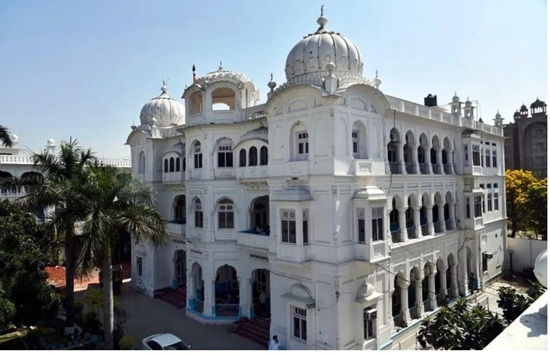
Teja Singh Samundri Hall, Sri Amritsar Sahib, HQ of SGPC.
The Hall That Bears His Name
In recognition of his sacrifice and his central role in building the SGPC as an institution, the Committee named its headquarters within the Golden Temple complex in Amritsar the Teja Singh Samundri Hall. To this day it houses the SGPC’s administrative offices and remains the nerve-centre from which Sikh religious institutions across Punjab and beyond are governed. Significantly, it is the only building within the Darbar Sahib complex named after an ordinary Sikh rather than after one of the Gurus — a singular honour in Sikh history, and a fitting memorial for a man who believed, above all, in institutions outliving individuals, and who consistently declined formal positions of authority for himself even as he shaped the architecture others would occupy.
It is worth noting, too, that the Sikh Gurdwaras Act of 1925 — whose clauses Sardar Samundri had studied line by line as a prisoner in Lahore Fort alongside Master Tara Singh and others — extended the vote to Sikh women a full year ahead of Punjab’s general franchise reforms of 1926, making the SGPC one of the earliest representative bodies in India to enfranchise women.
The Next Generation
Sardar Samundri’s son, Bishan Singh Samundri, carried the family’s commitment to education forward, serving as Principal of Khalsa College, Amritsar, before becoming the founding Vice-Chancellor of Guru Nanak Dev University in 1969 — an institution that today stands among Punjab’s foremost centres of higher learning. He was honoured with the Bhai Vir Singh International Award in 1993.
His wife, Dr Jagjit Kaur Sandhu, earned a doctorate in the United States and returned to serve as Principal of the Government College for Women, Amritsar. Family accounts place her doctorate between 1956 and 1958, completed, they say, in record time — a rare feat at a time when Indian women pursuing doctoral study in the United States were themselves a rarity.
Their sons have each, in their own domains, continued the family’s tradition of public service. Jasjit Singh Samundri, the elder, served the Indian Forest Service for some 38 years, retiring as Conservator of Forests, Punjab, and has since remained active with environmental and heritage causes, including the Punjab Heritage & Education Foundation.
His younger brother, Taranjit Singh Sandhu, joined the Indian Foreign Service in 1988, went on to serve as India’s Ambassador to the United States from 2020 to 2024, and was appointed the 21st Lieutenant Governor of Delhi in March 2026 — a rare instance of a career diplomat assuming charge of the National Capital Territory. In his public remarks, Sandhu has not shied from invoking his grandfather’s memory, including his description of Sardar Samundri as having been eulogised by Bhai Vir Singh as a “Param Pavitra Shaheed” — a supremely pure martyr — in the pages of Khalsa Samachar.
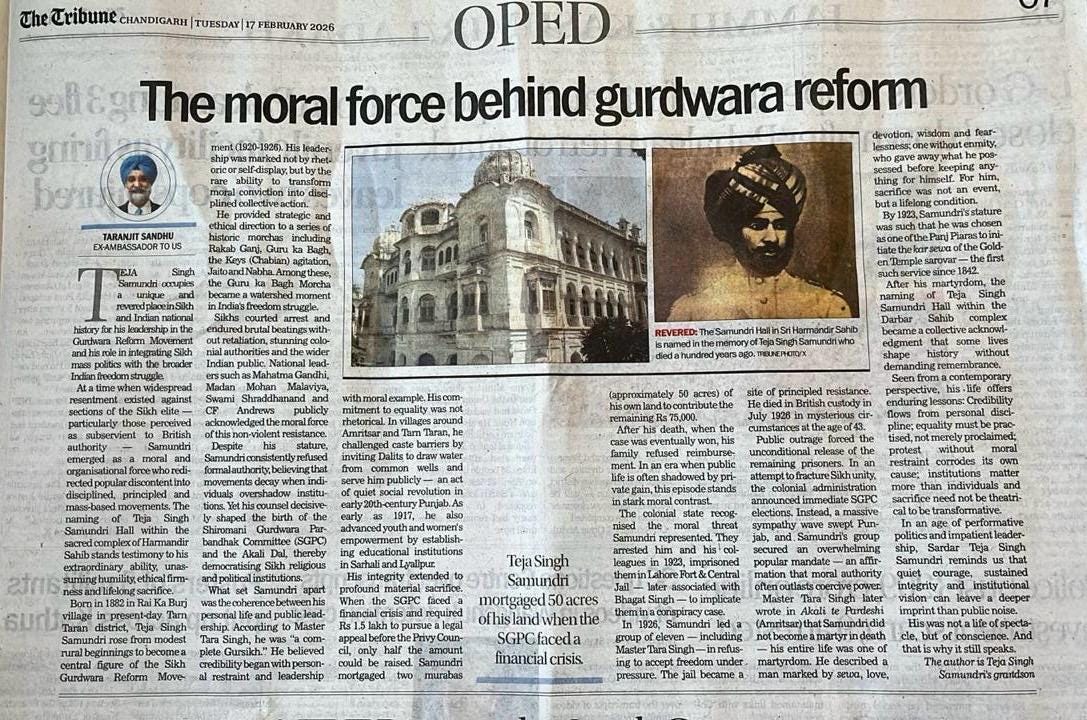
In February 2026, Sandhu set down his own tribute to his grandfather in The Tribune, under the title “The moral force behind gurdwara reform,” recalling — among much else — that the Congress-led national movement had once sought to draw Sardar Samundri into its Working Committee, in recognition of his rare capacity to fuse religious reform with national liberation. Months later, the definitive Punjabi biography of Sardar Samundri — authored by Dr Piar Singh and published by Guru Nanak Dev University — was translated into English by the University’s Vice-Chancellor, Karamjeet Singh, and formally released by Punjab Governor Gulab Chand Kataria and Sandhu himself at a function in Amritsar: grandfather and grandson meeting once more, this time on the page.
A Century of Remembrance
As we mark, tomorrow, a hundred years since the liberation of the gurdwaras from mahant control, it is worth pausing on how much of that emancipation was purchased not by dramatic confrontation alone, but by men like Sardar Samundri, who built patiently, argued firmly, and finally gave their lives rather than compromise on principle. The sacrifices of that generation, quiet and largely unsung outside Sikh institutional memory, deserve to be remembered by those who never knew how the Panth won back its own houses of worship.
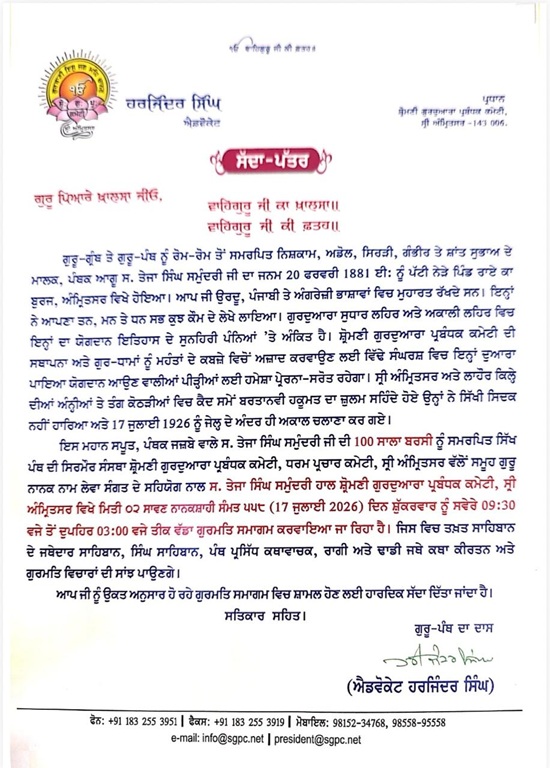
It is fitting, then, that tomorrow, Friday, 17th July 2026 — the centenary of his death to the day — two commemorations will unfold in tandem. At the Teja Singh Samundri Hall in Amritsar itself, the SGPC’s Dharam Parchar Committee will host a Gurmat Samagam from 9:30 AM to 3:00 PM, with Jathedars of the Takht Sahibs, Singh Sahiban and ragi and dhadi jathas offering kirtan and reflection at the very institution his sacrifice built. And in New Delhi, a Shabad Kirtan by Padma Shri awardee Bhai Harjinder Singh (Srinagar Wale) will be held at the Bhai Lakhi Shah Vanjara Hall of Gurdwara Rakabganj Sahib, the very shrine whose boundary wall Sardar Samundri once volunteered to die defending.
The invitation for the Delhi event comes from Taranjit Singh Sandhu, present Lieutenant Governor of Delhi and Sardar Samundri’s grandson, closing a circle a century in the making — a grandson keeping faith, in the seat of the National Capital, with the grandfather whose sacrifice he has spent a public career invoking.
July 17, 2026
-

-
KBS Sidhu, Former Special Chief Secretary Punjab
kbs.sidhu@gmail.com
Disclaimer : The opinions expressed within this article are the personal opinions of the writer/author. The facts and opinions appearing in the article do not reflect the views of Babushahi.com or Tirchhi Nazar Media. Babushahi.com or Tirchhi Nazar Media does not assume any responsibility or liability for the same.