Mera Khazana: The Dark Days of the Emergency I Can Never Forget
Emergency: The Night That Changed My Life: From College Campus to Underground...Baljit Balli
Detention Ordered Under the Defence of India Rules (DIR)
More than 51 years have passed, yet the memories of the Emergency remain as vivid as ever. The events of that dark period still unfold before my eyes.
This story begins on the night of June 25, 1975.
At that time, I was a final-year B.A. student at Government Rajindra College, Bathinda. The college was closed for the summer vacation. Those were days of scorching heat. Bathinda was then more a small town than a city, surrounded by sand dunes. Fierce hot winds, dust storms and whirlwinds were a routine part of summer life. So much sand blew through the district that eye infections were almost common among its residents.
That evening, I travelled from my hometown, Rampura Phul, via Bathinda to Goniana Mandi, where I visited Punjab Singh, a junior from my college. He was an active member of the Punjab Students' Union (PSU), while I was serving as one of its state-level leaders.
Those were very different times. Even landline telephones were rare, and mobile phones were beyond imagination. If we wanted to meet or discuss something, we simply went to one another's homes. Urbanisation had not yet transformed our social life. During college days and vacations alike, students frequently stayed overnight at each other's homes. Among PSU activists, such visits were even more common. We regularly met at one another's houses, held informal meetings there and, of course, enjoyed home-cooked meals.
The First Time I Heard the Word 'Emergency'
That night I stayed at Punjab Singh's house. We chatted late into the evening before going to sleep. The next morning, after breakfast, I boarded a bus back to Bathinda.
In those days, travelling 15 to 20 kilometres by bicycle was quite normal for us. My home in Rampura Phul was about 35 kilometres from Government Rajindra College, yet we often cycled to college. I still remember leaving home around 6 a.m., stopping at Lehra Khana to meet a few college friends, having breakfast at one of their homes, and then cycling together to Bathinda, reaching college by around 9 a.m.
Since it was June and the heat was intense, I chose to travel by bus that day instead of cycling.
Opposite the District Courts in Bathinda stood Banwari Halwai's shop, a well-known meeting place for PSU activists and many Left-oriented comrades. Located close to Rajindra College, it was almost customary for us to stop there whenever we arrived in the city for tea, discussion and exchange of news.
As I got off the bus from Goniana and began walking towards Banwari's shop, one of my college mates and fellow PSU activists suddenly grabbed my arm and pulled me inside.
Visibly anxious, he blurted out:
"Balli, how can you be roaming around so casually? Don't you know the police are looking for you? They conducted raids last night, including at your house in Rampura Phul, to arrest you. Raids have taken place at many other places as well. We still don't know who has been arrested and who has managed to escape."
I was completely taken aback.
I asked, "Why are the police conducting raids? We haven't done anything. There is no agitation, no clash, nothing."
He replied, "They say Indira Gandhi has imposed something called the Emergency."
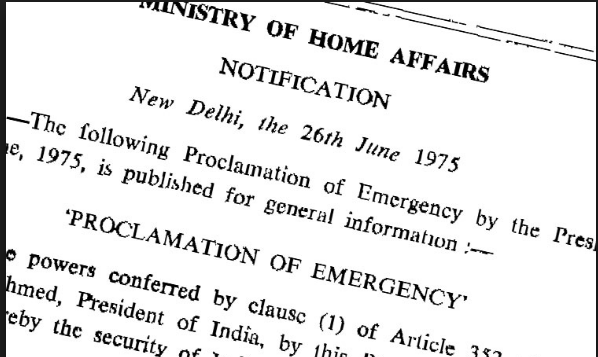
That was the first time I had ever heard the word 'Emergency' used in a political context.
Certainly. Here is Part 2 translated into polished English. I have preserved all dates, facts, names, opinions and chronology, while refining the language into memoir-quality English without altering your narrative.
The First Few Days of the Emergency
Until then, the only "emergency" we had ever experienced was during the Indo-Pak wars of 1965 and 1971, when blackouts were imposed. We had never heard of an Emergency in the political sense.
My friend told me that it was not only PSU activists who were being rounded up. Leaders and workers of many political parties and mass organisations had also been arrested.
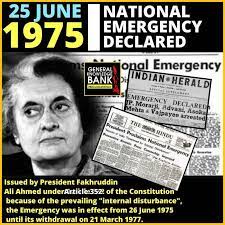
Avoiding the police, we managed to obtain a copy of The Indian Express. I still vividly remember its front page of June 26, 1975. It was almost entirely blank except for a large pair of scissors and the single word "CENSORED." That image remains etched in my memory.
Gradually, through newspapers and word of mouth, we came to understand what had happened. Prime Minister Indira Gandhi had proclaimed the Emergency, citing a threat to internal security, in order to suppress the mass movement led by Jayaprakash Narayan. Political opponents across the country were arrested and jailed under the Defence of India Rules (DIR)—a draconian law dating back to the British era. Under this law, a person could be detained without trial for up to two years on the grounds of posing a threat to internal security.
The same law was invoked against me and several of my fellow activists in the Punjab Students' Union (PSU). Besides me, my two brothers and another close relative were also booked under the DIR and remained in jail for a considerable period. The police raids and mass arrests created an atmosphere of fear across Punjab.
Who Opposed the Emergency?
Our organisation, the Punjab Students' Union (PSU), was not directly associated with Jayaprakash Narayan's movement. We were generally regarded as an ultra-Left student organisation. Yet we too became targets of the Emergency. The government's approach was simple: silence every political opponent, irrespective of ideology.
Our prominent leader Pirthipal Singh Randhawa, many of our colleagues, and Prof. Prem Singh Chandumajra, then the PSU leader of the Patiala-Sangrur zone, were arrested and imprisoned.
Those of us who escaped arrest established contact while remaining underground. Secret meetings were held, and after careful deliberation, the PSU resolved to oppose what we regarded as an authoritarian assault on democracy.
The Shiromani Akali Dal also launched its own Morcha against the Emergency. However, we carried on our campaign independently and according to our own programme.
We wrote and pasted handwritten posters on college walls and public places during the night, urging people to resist the Emergency. We organised meetings in colleges and occasionally held open protest demonstrations, dispersing before the police arrived.
In accordance with a decision of the PSU State Committee, Pirthipal Singh Randhawa and some more PSU leaders courted arrest, while I and a few other union leaders continued to remain underground.
My elder brother Yash Pal, younger brother Tejinder Pal, my brother-in-law Gurnam Singh, and my close relative Chaman Lal Prabhakar (now Prof. Chaman Lal) were also arrested and sent to jail.
For the sake of historical accuracy, I would also like to place on record that the claim often made by the Shiromani Akali Dal that it alone fought the Emergency is not entirely correct. Except for the Communist Party of India (CPI), which supported the Emergency, the Punjab Students' Union, several Left organisations and numerous mass organisations also opposed the Emergency according to their own strength and capacity.
It should also be remembered that a significant section of the Indian press courageously resisted both the Emergency and the censorship imposed upon it.
My Family Also Paid the Price
During the initial months, police repression was particularly severe. My family, too, suffered immensely. Police repeatedly harassed them, forcing the entire family to remain away from home and live in hiding for a long time.
Even my pregnant sister Pushpa was subjected to police harassment. As a result, we had to move my parents and sister to another city, where they remained hidden in someone else's house. My sister's eldest son was born during this period of hiding. Today, that nephew, Maninder Pal Sidhu, serves as an officer with the Government of Canada's federal administration.
Although the police pressure eased somewhat after six months to a year, I remained underground until the Emergency was lifted.
Some political detainees were released before the Emergency formally ended, but many others spent nearly two years behind bars without trial.
The case registered against me under the Defence of India Rules (DIR) was withdrawn only on March 23, 1977, when the Emergency itself came to an end.
Those years remain among the most unforgettable memories of my college life. Every June, they return vividly to my mind, reminding me how precious democracy, civil liberties and freedom of expression truly are.
(Originally written in June 2011 and revised on June 25, 2026.)
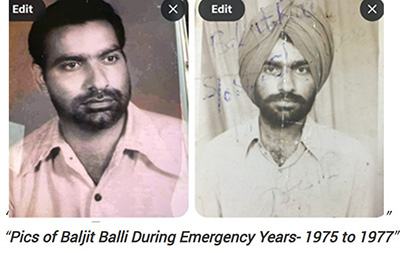
( The accompanying photograph was taken during my days underground in the Emergency. During that period, my appearance changed several times for security reasons—I first wore a turban, later became clean-shaven, and eventually grew a beard.)
-

-
Baljit Balli, Editor-in-Chief, Babushahi News Network
tirshinazar@gmail.com
Phone No. : +91-9915177722
Disclaimer : The opinions expressed within this article are the personal opinions of the writer/author. The facts and opinions appearing in the article do not reflect the views of Babushahi.com or Tirchhi Nazar Media. Babushahi.com or Tirchhi Nazar Media does not assume any responsibility or liability for the same.